Urrak vs. Feni: Understanding the Science of the First Distillation
In the global lexicon of spirits, there is a tendency to categorize drinks by their base ingredient. Agave gives us Tequila, juniper gives us Gin, and the cashew apple gives us Feni. But for the Goan local, this classification is too broad. It ignores the most crucial variable in the distillation calendar: the stripping run.
To understand the difference between Urrak and Feni is to understand the physics of the bhann (the traditional copper or clay pot) and the chemistry of the cashew apple’s volatile esters. In 2026, as the world moves toward low-ABV craft spirits, Urrak is finally being recognized for what it is: a masterclass in artisanal distillation that refuses to be bottled or rushed.
The Pre-Distillation Alchemy: The Niro Stage
The journey begins not at the still, but on the kolmbi (stone floor). When the cashew apples are stomped, the first run of juice is called Niro.
In the chemical lifecycle of the spirit, Niro is the virgin state. It is a thick, opaque nectar, high in natural sugars and Vitamin C, with zero alcohol content. For the distiller, the Niro stage is a race against time. Because the ambient temperature in a Goan March often hits 32°C, the wild yeasts present on the cashew skins begin a furious fermentation.
In 2026, we are seeing a revival of Niro as a standalone craft beverage, often flash-chilled and served as a seasonal probiotic. However, for the Urrak-maker, the Niro must be allowed to reach a specific gravity over 72 hours of bubbling in underground earthen vats. This fermented wash is what provides the ester-heavy profile that defines a first-press Urrak.
Phase One: The Birth of Urrak (The Stripping Run)
The first distillation is where the soul of the spirit is captured. The fermented juice is poured into the bhann and heated over a slow, consistent wood fire.
As the liquid boils, the alcohol vapors rise and travel through a conduit, traditionally a bamboo pipe cooled by a continuous flow of water, where they condense back into liquid. This first distillate is Urrak.
- The Science of Proof: Urrak is pulled at approximately 15% to 25% ABV. Because the distillation ends early, the liquid retains a high concentration of fruit sediments and aromatic esters.
- The Profile: It is cloudy, opaque, and fruit-forward. It carries the raw, funky perfume of the cashew orchard that higher distillation would strip away.
- The Shelf Life: Chemically, Urrak is unstable. Because of its low alcohol content and high organic matter, it cannot be aged. It is a living spirit meant for immediate consumption.

Phase Two: The Evolution into Feni (The Rectification)
Feni is not a different drink; it is the chemical evolution of the first run. To produce Feni, the distiller takes the Urrak and mixes it with a fresh batch of fermented juice. This mixture undergoes a second distillation.
- The Rectification: This second pass acts as a purifier. The alcohol content jumps significantly, usually landing between 40% and 45% ABV.
- The Stability: High-proof Feni is chemically stable. Like a fine Mezcal, it can be aged in glass or oak, where its sharp edges mellow into notes of pepper and earth.
Comparison: At a Glance
|
Feature |
Urrak (First Press) |
Feni (Double Distilled) |
|
ABV |
15% to 25% |
40% to 45% |
|
Appearance |
Cloudy, milky white |
Crystal clear |
|
Aroma |
Raw, intense fruit |
Sharp, peppery, complex |
|
Stability |
Highly Perishable |
Shelf-stable (Ages well) |
The 2026 Shift: Mixology through the Lens of Science
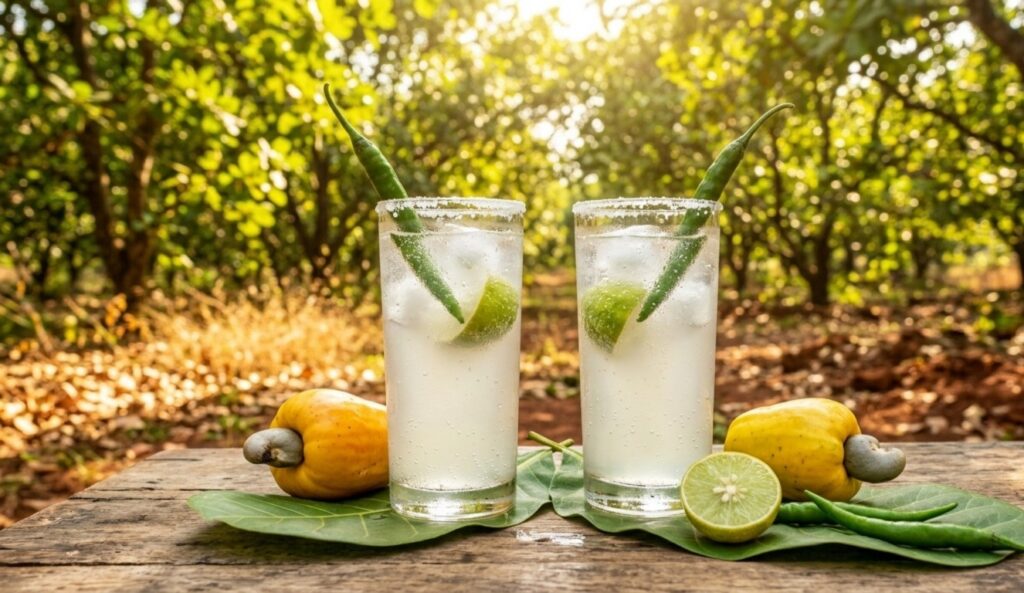
While the tavernas stick to the salt-and-chili ritual, 2026 bar programs are leveraging Urrak’s high viscosity for what is being called Tropical Modernism.
Joseph Bar in Panjim remains the essential bridge, bringing tavern culture to the urban Latin Quarter. Meanwhile, bars like Hideaway in Vagator treat the spirit with the reverence of a craft botanical. Mixologists are now using Urrak’s natural cloudiness to create clarified milk punches, proving that this “jungle juice” has the sophistication to lead a high-end cocktail program.
Understanding the science of the first distillation changes how you consume it. When you sit at a local tavern like Nilima, Mhambrey’s or Vijesh Bar, you aren’t just drinking local moonshine. You are drinking a precisely timed chemical reaction: a marriage of folk wisdom and thermal dynamics. In a world of standardized, neutral spirits, the imperfect science of Urrak is Goa’s most authentic remaining truth.
Recently published

Welcome Traveller!
From hidden gems in India to international adventures, I focus on honest recommendations, smart travel ideas, and experiences that are worth your time and money. My goal is simple — inspire people to travel more, explore deeper, and experience destinations beyond the usual tourist checklist.