
I Walked Into Kashi Vishwanath Looking for Answers. I Walked Out With Something Else
An evening at the Shayan Aarti, an unexpected flood of tears, and a lesson about faith that had nothing to do with religion.
There are some journeys we plan because we’ve always wanted to visit a place. We bookmark photographs, watch videos, read itineraries, and slowly build an image of what that destination will feel like long before we arrive. Then there are journeys that quietly arrive at exactly the right moment in our lives. They begin like any other trip, but somewhere along the way they stop being about the destination and start becoming about us.
My visit to Kashi Vishwanath Temple in Varanasi was one of those journeys.
If someone had asked me then why I wanted to visit Kashi, I would have probably spoken about its history, its spirituality, or its place in India’s cultural fabric. I wanted to witness the famous Shayan Aarti, walk through the centuries-old lanes of Varanasi, and experience a city that millions consider the spiritual heart of India. Every one of those reasons was true. But looking back today, I realise there was another reason I hadn’t fully acknowledged, even to myself.
I had arrived carrying questions that had nothing to do with travel.
A few weeks before that trip, I had left my job. It wasn’t an impulsive decision, nor was it one I regretted, but it left me standing in unfamiliar territory. For the first time in years, I couldn’t clearly picture what the next chapter of my life looked like. Friends congratulated me for taking a leap of faith, and people spoke about courage, new beginnings, and following your dreams. Those conversations were encouraging, but they also overlooked a quieter reality that rarely makes its way into success stories. When certainty disappears, everyday life begins to feel different. Every morning starts with questions you can’t answer, and every small decision suddenly feels heavier than it should.
I wasn’t afraid of working hard. I’ve always believed that meaningful work demands patience, consistency, and a willingness to fail before succeeding. What unsettled me wasn’t the effort that lay ahead. It was the absence of direction. I no longer knew where all that effort was leading, and that uncertainty followed me everywhere. It sat beside me during meals, interrupted moments that should have felt joyful, and quietly reminded me that I no longer had a roadmap for the future.
That was the version of me that arrived in Varanasi.
Not broken.
Not hopeless.
Just searching.
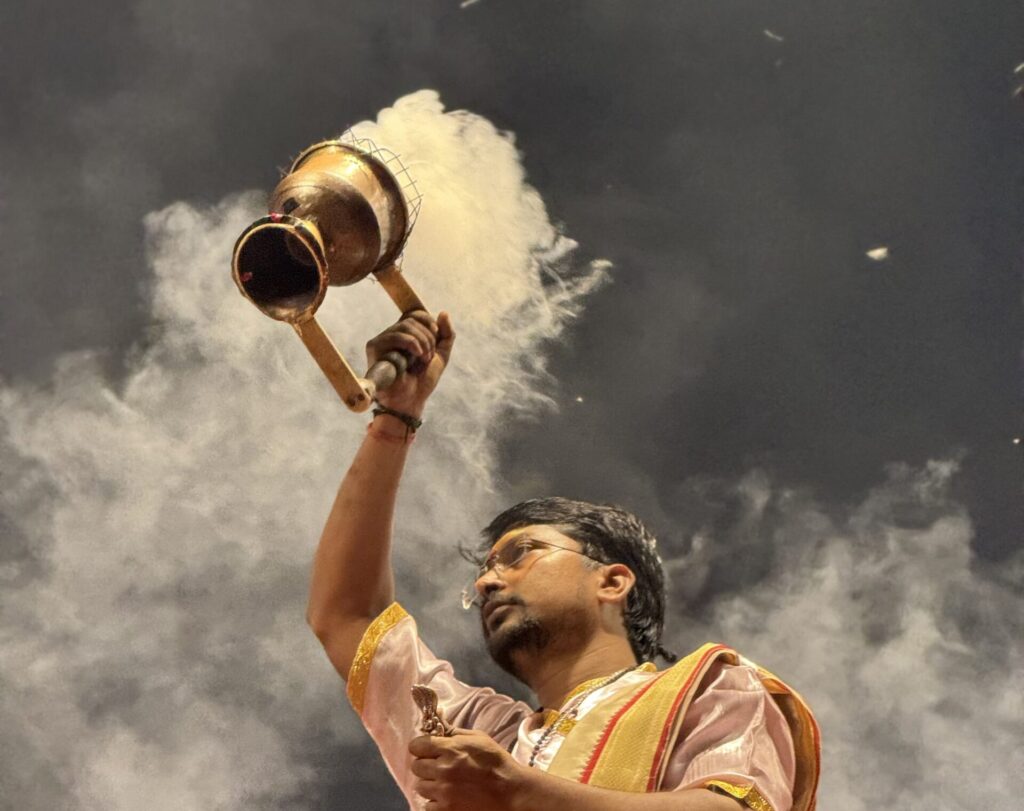
A city that has never needed to explain itself
People often describe Varanasi as one of the oldest continuously inhabited cities in the world. While that fact is remarkable, it doesn’t prepare you for what the city actually feels like. Some destinations make an immediate effort to impress visitors. They present their best side first, easing you into the experience with broad roads, organised attractions, and carefully curated moments. Varanasi does none of that.
It simply exists.
The lanes are narrow enough that two strangers instinctively turn sideways to pass each other, yet somehow they accommodate pilgrims, priests, flower sellers, scooters, wandering cows, and curious travellers without collapsing into chaos. The air carries the fragrance of incense, fresh marigolds, chai, and street food all at once. Temple bells echo from somewhere beyond the buildings, conversations overlap in half a dozen languages, and every few steps reveal another small shrine that people pause before without drawing attention to themselves.
Nothing feels staged.
Nothing feels manufactured for tourism.
That was perhaps the first thing that struck me about Varanasi. The city isn’t trying to perform for anyone. It has existed for centuries before social media, before guidebooks, before tourism campaigns, and it carries itself with the confidence of a place that doesn’t need your approval.
As someone who travels often, I’ve realised that popularity changes many destinations. Places slowly begin adapting themselves to visitors. Experiences become polished, predictable, and easier to consume. Varanasi, despite welcoming millions every year, still feels wonderfully indifferent to expectation. It asks nothing of you except your presence.
The more I walked through its streets, the more I understood that Varanasi isn’t a city you conquer in two days. It isn’t something you fully understand through monuments or historical facts. You experience it through observation. By slowing your pace. By allowing yourself to become part of its rhythm instead of expecting the city to adapt to yours.
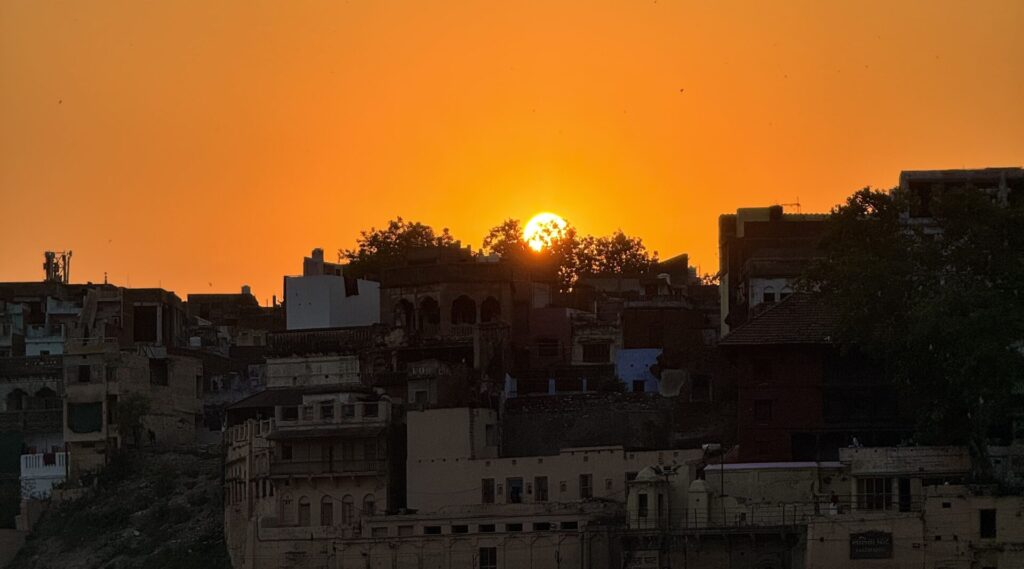
Faith has never had boundaries for me
One question I often get whenever I share photographs from temples is about my own faith.
The answer has always been simple.
I was born and raised Catholic, and my faith continues to be an important part of my life. But I have also spent years visiting temples, gurudwaras, monasteries, and places of worship belonging to different traditions. I’ve never felt that respect for one faith requires distance from another.
Perhaps that’s because I’ve always seen spirituality differently.
To me, spirituality has never been about proving which path is right. It has always been about recognising those moments when you genuinely feel connected to something greater than yourself. That feeling can arrive inside a quiet church just as easily as it can inside an ancient temple. It can emerge through prayer, through silence, through music, or simply by standing in a place where millions before you have searched for hope.
I’ve never believed that reverence belongs to a single religion.
It belongs wherever your heart becomes still.
That belief made walking towards Kashi Vishwanath feel surprisingly natural. I wasn’t entering the temple as someone trying to understand another religion from the outside. I was entering as someone carrying his own questions, hoping that perhaps, somewhere in the middle of all that devotion, I might find a little clarity.
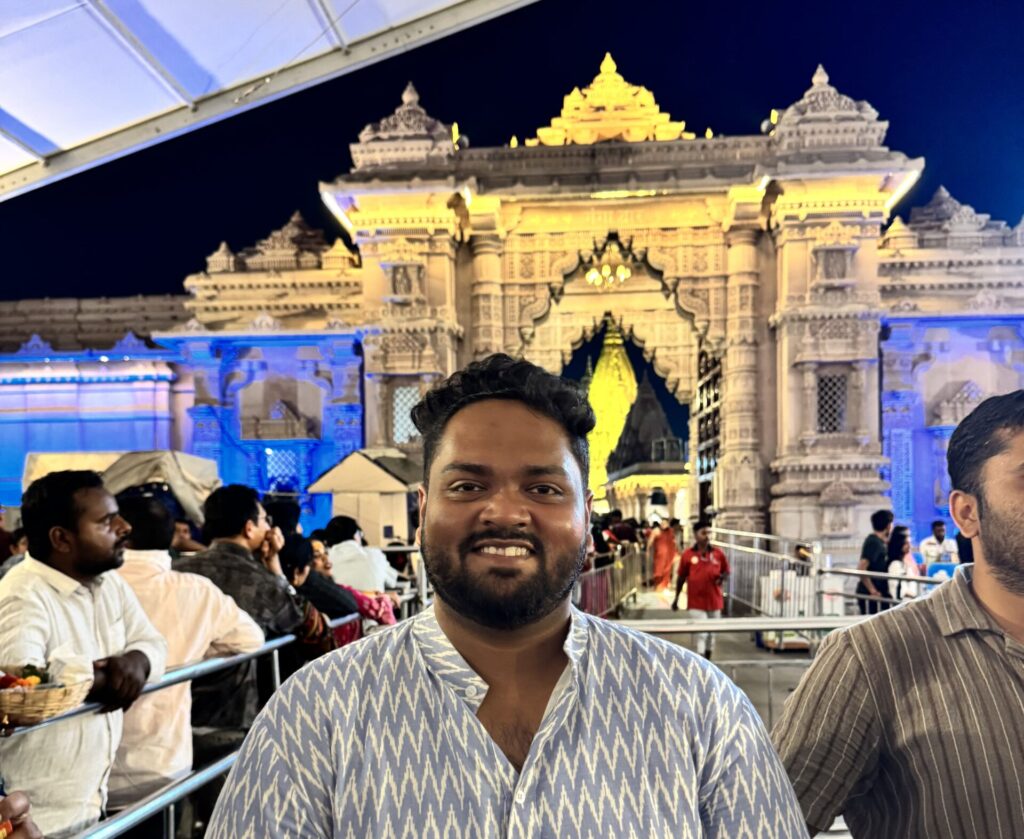
Waiting for the Shayan Aarti
Before travelling to Varanasi, I had read about the different rituals performed at Kashi Vishwanath Temple. Each one carries its own significance, but there was something about the Shayan Aarti that drew me in. Performed late in the evening before the deity is symbolically put to rest for the night, it felt less like a spectacle and more like an intimate conclusion to the day’s worship. I didn’t know what to expect, but I knew I wanted to experience it.
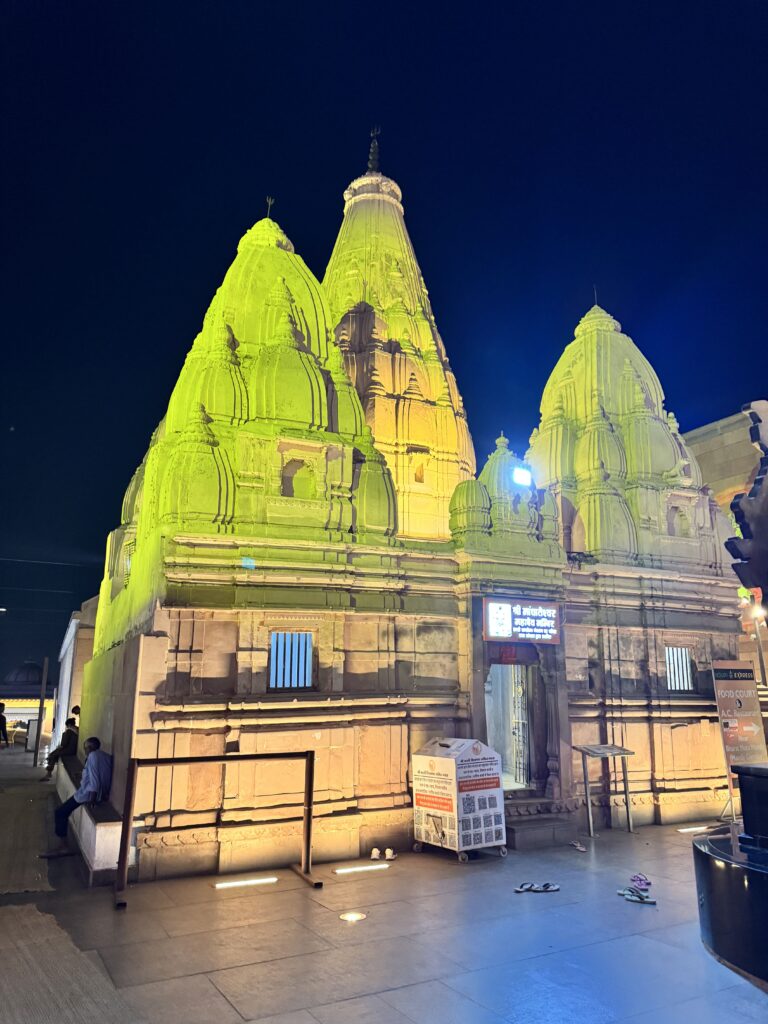
By the time I reached the temple, the atmosphere had already begun to change. The closer I walked, the more conversations gave way to chants. The fragrance of incense became stronger, mingling with the scent of flowers and burning lamps until the entire space seemed wrapped in a warmth that felt both unfamiliar and strangely comforting. Hundreds of devotees had gathered, each carrying their own silent prayers, yet despite the crowd there was remarkably little impatience. People waited with a quiet sense of purpose, as though everyone understood that the experience itself was worth more than the wait.
What happened next is something I still struggle to explain.
With the number of people present, I had fully expected to spend a considerable amount of time in the queue. Instead, I somehow found myself entering just as the Shayan Aarti was beginning. Even today, I don’t know how it happened. Maybe it was simply good timing. Maybe it was luck. Whatever the reason, I reached the public viewing area without the long wait I had mentally prepared myself for.
Sometimes travel gifts us moments that cannot be planned.
This was one of them.
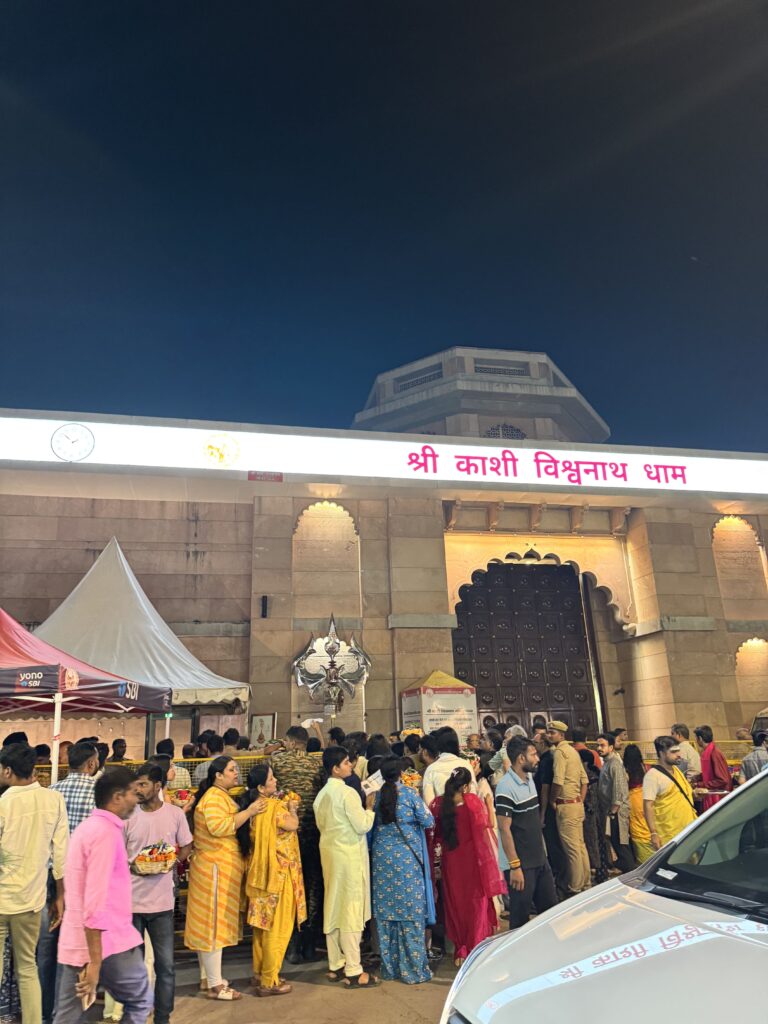
When the tears came
The aarti began without drama. There was no single moment designed to overwhelm the senses. Instead, the experience unfolded gradually. The chants rose together in a rhythm that felt timeless, while the temple bells echoed through the corridors with a depth that seemed to linger long after each note faded. Priests moved with remarkable grace, every gesture measured, every ritual performed with a sense of devotion that could only come from years of repetition without ever losing meaning.
Around me, hundreds of people stood in complete silence. Some had their eyes closed in prayer. Others folded their hands and watched intently. Families stood together. Elderly devotees leaned gently against the railings. Young children, unusually quiet, looked on with curiosity. For those few minutes, everyone seemed connected by something that needed no explanation.
I watched.
I listened.
I allowed the moment to settle.
And then, without warning, tears began rolling down my face.
At first, I thought it was simply emotion. After all, I had travelled all the way to one of the most sacred temples in Hinduism. Perhaps it was the chants, the bells, or the sheer atmosphere of the place. But the tears didn’t stop. They continued quietly, almost gently, until I realised I wasn’t able to control them anymore.
It wasn’t sadness.
It wasn’t joy either.
Even today, if someone asked me why I cried that evening, I wouldn’t know how to answer with certainty.
I’ve thought about it countless times since returning home. Was it weeks of uncertainty finally catching up with me? Was it standing in a place where millions before me had arrived carrying burdens of their own? Or was it simply one of those rare moments in life that are felt more deeply than they can ever be understood?
The truth is, I don’t know.
And over time, I’ve realised that not knowing doesn’t diminish the experience. If anything, it has made it even more meaningful.
For those few minutes, standing there amidst the chants, the bells, and the fragrance of incense, I stopped trying to solve my life. The questions that had followed me for weeks didn’t suddenly disappear, but they became quieter. It was as though my mind, exhausted from constantly searching for answers, had finally found permission to rest.
The Shayan Aarti eventually drew to a close, but I stayed where I was for a few moments longer. Around me, the temple slowly returned to its familiar rhythm. People began moving towards the exits, families reunited after standing in different sections, and conversations quietly replaced the chants that had filled the air only moments earlier. I remember wiping my face, taking a deep breath, and wondering what had just happened. Nothing extraordinary had occurred in the conventional sense. I hadn’t witnessed a miracle or heard a voice offering answers to the questions I had been carrying for weeks. Yet something inside me had undeniably shifted.
Soon after, I had the opportunity to move closer for darshan. Watching the Shayan Aarti from the public viewing area had been an experience in itself, but standing before the Shivling felt far more personal. The crowd was still there, yet everything around me seemed to fade into the background. It wasn’t because the temple had suddenly become quiet. Rather, the noise inside my own mind had finally softened enough for me to be present.
People often ask what I prayed for that evening. They expect a list of wishes or perhaps a moment of divine revelation. The truth is far simpler.
I didn’t ask for success.
I didn’t ask for money.
I didn’t even ask for certainty.
Standing before the Shivling, I folded my hands and admitted something I had been struggling to admit to myself ever since leaving my job.
“I don’t know where life is going.”
That was my prayer.
I told Shiva that I had walked away from something familiar without knowing what lay ahead. I didn’t have a perfectly crafted plan. I wasn’t sure whether I had made the right decision. I simply asked Him to see what I couldn’t. Looking back, I think those final words mattered more than anything else I said.
You see it.
There was an unexpected comfort in believing that I didn’t have to explain everything. I didn’t have to justify my decisions or convince anyone, including myself, that I had everything under control. For weeks, I had been carrying my uncertainty as though it was my responsibility to solve immediately. Standing inside Kashi Vishwanath Temple, I realised that perhaps faith isn’t about finding instant answers. Sometimes, it is about finding a place where you can safely lay your questions down for a while.
That moment didn’t erase my uncertainty. My future remained exactly as uncertain as it had been when I entered the temple. But my relationship with that uncertainty had begun to change.
As travellers, we often talk about destinations changing us. We return from a trip saying that a place transformed our perspective or taught us something about life. Over time, I’ve come to believe that destinations rarely change us on their own. More often, they reveal parts of ourselves that we were too distracted to notice before.
If I had visited Kashi Vishwanath during a period when life felt perfectly stable, perhaps I would have admired the temple’s history, appreciated the rituals, and left with beautiful memories. Instead, I arrived carrying doubt, and the experience met me exactly where I was emotionally. The temple didn’t create those feelings. It simply became the place where I finally acknowledged them.
That, to me, is what makes spiritual places so powerful. They don’t promise identical experiences. Two people can stand beside each other during the same aarti and walk away carrying completely different emotions. One may feel gratitude, another hope, another peace. Someone else may feel nothing at all. None of those experiences are more valid than the others.
Faith has always been deeply personal.
Perhaps that’s why it refuses to fit neatly into explanations.
I’ve often tried to understand why I cried that evening. Was it the chants echoing through the temple? Was it the rhythmic sound of the bells? Was it the fragrance of incense filling the air, or simply the emotional weight of everything I had been carrying? The honest answer is that I don’t know. Over time, I stopped trying to analyse it because I realised that not every meaningful experience needs to be reduced to a reason. Some moments are valuable precisely because they remain beyond explanation.
Recently published

Welcome Traveller!
From hidden gems in India to international adventures, I focus on honest recommendations, smart travel ideas, and experiences that are worth your time and money. My goal is simple — inspire people to travel more, explore deeper, and experience destinations beyond the usual tourist checklist.

